About this Blog

This is about the combination of two interests, Radio Control vehicles and Science Fiction models. This blog documents my science fiction spaceship and radio controlled vehicle projects.
Showing posts with label gearmotors. Show all posts

Sunday, 25 February 2018

Swamp Dawg 6X6 part 1

The name of this project series is due to the use of  the use of Imex Jumbo Maxx Swamp Dawg tyres which I like the proportion of a lot, sadly no longer available. They are mounted to Monster Pirate wheels that have a 17mm hex. These are then mounted to Traxxas 17mm hubs modified to fit on the 6mm shaft of the Gear-motors, one for each wheel. Steering will be spin steer, having a separate  forward and reverse speed controller ( a Traxxas EVX2) for each side's three wheels.

This is not exactly a new project, it has been hanging around in the background since the motor per wheel test rig post way back in 2015. It had not progressed much since then as there were certain mechanical design issues that I couldn't see clear practical solutions to, until very recently.


One of the stumbling blocks was due to the length of the cheap gear-motors when attached to my simple rectangular profile aluminium swing arm design. That design, which I put to use in the Reverse Trike project,  uses a hose clamp arrangement to attach the motor to the end of an aluminium swing arm. Mounting the swing arm to the side of a chassis means that on compression of the suspension, the motor will foul the bottom of the chassis. One solution was to mount the swing arm out from the chassis so far that the motor no longer fouls. I wasn't happy with how this looked from an aesthetic and mechanical point of view. The alternative was to make cutouts in the chassis to allow the motors to swing into the vacant space. I couldn't see any simple way to do this until I happened across some parts for 3d printers on Banggood.com and then out of the blue a solution to the problem formed in my mind.

Essentially I found a simple way of mounting the swing arm pivots lower than the structural part of the chassis so when the arms swing up for full compression of the suspension the motors just clear the bottom of the chassis. I ordered the parts which were very inexpensive and waited for them to arrive in the post to see if it would work.

Here is the result so far.


The chassis is two lengths of 4mm thick aluminium angle which was actually a piece of aluminium channel which I cut down the middle. These are spaced apart with 10mm square aluminium rod tapped M4 and screwed together with button head cap screws. Onto these rails I bolted the parts from Banggood starting with 8mm rod mounts using the holes provided with m5 cap screws and nuts. The mounting holes for the cheap rod mounts were very inaccurately drilled, with a 1mm variation in hole centre spacing as well as being offset from the centre line You would hope that the manufacturers would be able to achieve better tolerances than shown on this sample of 6. I had to grind away a bit of the aluminium rails to fit some nuts on the inside as the holes ended up very close to the angle.

200mm lengths of 8mm rod ( it comes in that length and I didn't even need to cut it) is then mounted with a spacer of brass tube on the outside. These rods are the pivots for the swing arms and as a bonus considerably stiffen up the chassis structure.

The swing arms have two flanged bearings with an 8mm ID and 16mm OD fitted into the 16 mm holes drilled with a step drill in to the rectangular aluminium profiles. The swing arms are retained with 8mm collars that have a locking grub-screw. A small piece of shaped aluminium channel is pop riveted to the top of the arms to mount the shock which are Traxxas Summit or Revo shocks. The top of the shocks are mounted with 25mm M3 cap screws and an 8mm diameter aluminium spacer  drilled and cut to length on the mini lathe.
I have been experimenting with the spring weights and wont know for sure what I'll use until the body is completed and the electronics and battery are all in place.

You can also see the hose clamp motor mount arrangement bolted to the end of the arm which has a circular cut out in its end the same diameter as the motor. This was cut  very carefully with a hole saw in the drill press and then cleaned up with a file. The motors need to sit at 90 degrees to the arm or the they wont track straight.

Wires to the motors will be fed back into a hole in the swing arm (yet to be drilled) and come out the other end to be fed back into the chassis for connection to the speed controllers, one for each side as per the previously mentioned motor per wheel test rig post. I might add that the swing arm motor assemblies were built shortly after the test in 2015 and have sat around in a box since then, waiting for  that little spark of inspiration to progress. The position of the top shock mounting point was determined by moving it about to different positions and clamping it and testing for operation until a spot was found that gave the right amount of stiffness and compression. I did this originally with one swing arm mounted to a scrap of plywood, Once I mounted the swing arms to the chassis I moved the position around further until I was happy with the motion.


I am planning to build an under chassis cover that will hide all the mounting hardware leaving spaces for the motors to fold back into.

Next to be tackled was the design of the body. I've been toying with ideas for 6X6 vehicles for some years coming up with a number of designs over that time but never really finding one that exited me enough to start building. While running off 150 of the same part on the CNC machine at work recently, I doodled away on a bit of paper and came up with a thumbnail that I liked.


 I then took a photograph of the chassis and the wheels with my phone camera, threw that into photoshop and tried to come up with a side view. My painting skills are pretty dodgy at best but I managed to come up with an image that I thought fitted the chassis and wheels in good proportion along the lines suggested by the thumbnail.


  I then took that image into DraftSight and proceeded to draw up some lines and dimensions to start the build.


I then took this cad drawing and drew up onto paper full size the side view ready to cut some styrene, in this case 1.5mm thick. I chose the 1.5mm styrene over Foamed PVC in this case because for one I had a full sheet of it and the design is mostly flat sided or curved in only one dimension not curved in multiple dimensions like the Reverse trike project. It's not as heavy as 2mm styrene which I have used for a lot of previous projects and it's always a good idea to try to keep the weight down when making these vehicles wherever possible.

Here are some shots of the body structure under construction.


It starts of being rather flimsy at first but as the skin gets added the strength and rigidity increases.
Most of the edges get doublers to increase the gluing surface area and the bulkheads get small re-inforcing strips added to the inside of the skin for the same reason. There are only three bulkheads in the structure but I added some localised small buttresses in-between to help shore up the side panels and stop them flapping around while I beveled the edges to receive the bevel sheet which, as can be seen, is still to do. The cabin side wall is just temporarily stuck on with double sided tape to get an idea of its shape and proportion.


I dug out these small action figures ($3.00 from Target) which are 105mm tall making  them 1/17 scale if they represent the average height of 1800mm.  They could be a short 1/16 scale or a tall 1/18 scale as well. Anyway they seem about right for the size of the vehicle that I want to imply, generally pretty big.


 Dont forget that if you click on a picture it will display much larger on your screen.
Thanks for reading, more soon...

Tuesday, 8 August 2017

ToyBash 2 part 1

True to form I started a new project, when I have so many others crying out for completion.

I have had the tracked lower section of the Bruder dozer toy from the original ToyBash truck project lying around without any concept of what to do with it . Very recently I acquired a Wall E Truck toy on ebay and when it arrived in the post I had an idea about combining the two.


But before that I wanted to be see if I could add a drive mechanism to the Bruder tracks so they could be radio controlled. I had a couple of gear motors, another ebay find, which were were very cheap at around $12.00 (including postage from China) and have  really well made metal gears inside a plastic housing. The question was would they fit into the space available in the Bruder chassis at the correct track width. After a bit of measurement it looked like they could be just squeezed in. I built a sturdy mount from aluminium angle and a bit of 3mm sheet and then hacked away at the ABS plastic of the chassis  so the whole unit could be slid into position. Some epoxy putty was slapped into the rear of the chassis and a piece of PVC sheet superglued in to the middle allowing for tapped holes so the mount could be securely bolted in place with m4 cap screws.


At 12 volts with no load they produce  only 70 rpm which may be a bit slow so we will see how that works out in due course.
The Bruder dozer has molded-in fake rollers that the tracks just slide over. I wanted to reduce the friction so I decided to try and modify the track supports and add actual rolling rollers. I hacked away all the bits of ABS that were the non-functioning rollers leaving the support brackets. These were then drilled to take a 2mm piano wire pin cut with a Dremel metal cut of disc. The rollers needed to be 16mm in diameter, I had some 12mm PVC rod and then found some PVC conduit in my stock with a 12mm ID and a 16mm OD, so in my mini lathe I machined up 16 sets of roller parts. I also made the top track return roller using the original molded ABS one I cut off. In the picture below you can see the modified track support above with the un-modified version still with the non-working rollers at the bottom.


I mostly used pair of electronic flush cutting nippers to hack away the unwanted plastic along with a razor saw and much careful sanding and filing. Below is another comparison of before and after on the track supports plus the new rollers and pins.


The separate roller parts were glued together with thin superglue wicked into the join and then once set they were assembled with the pins being retained with another small drop of thin superglue, being careful not to get any on the rollers. The result has been quite successful the tracks now roll smoothly along and the friction has been substantially reduced.


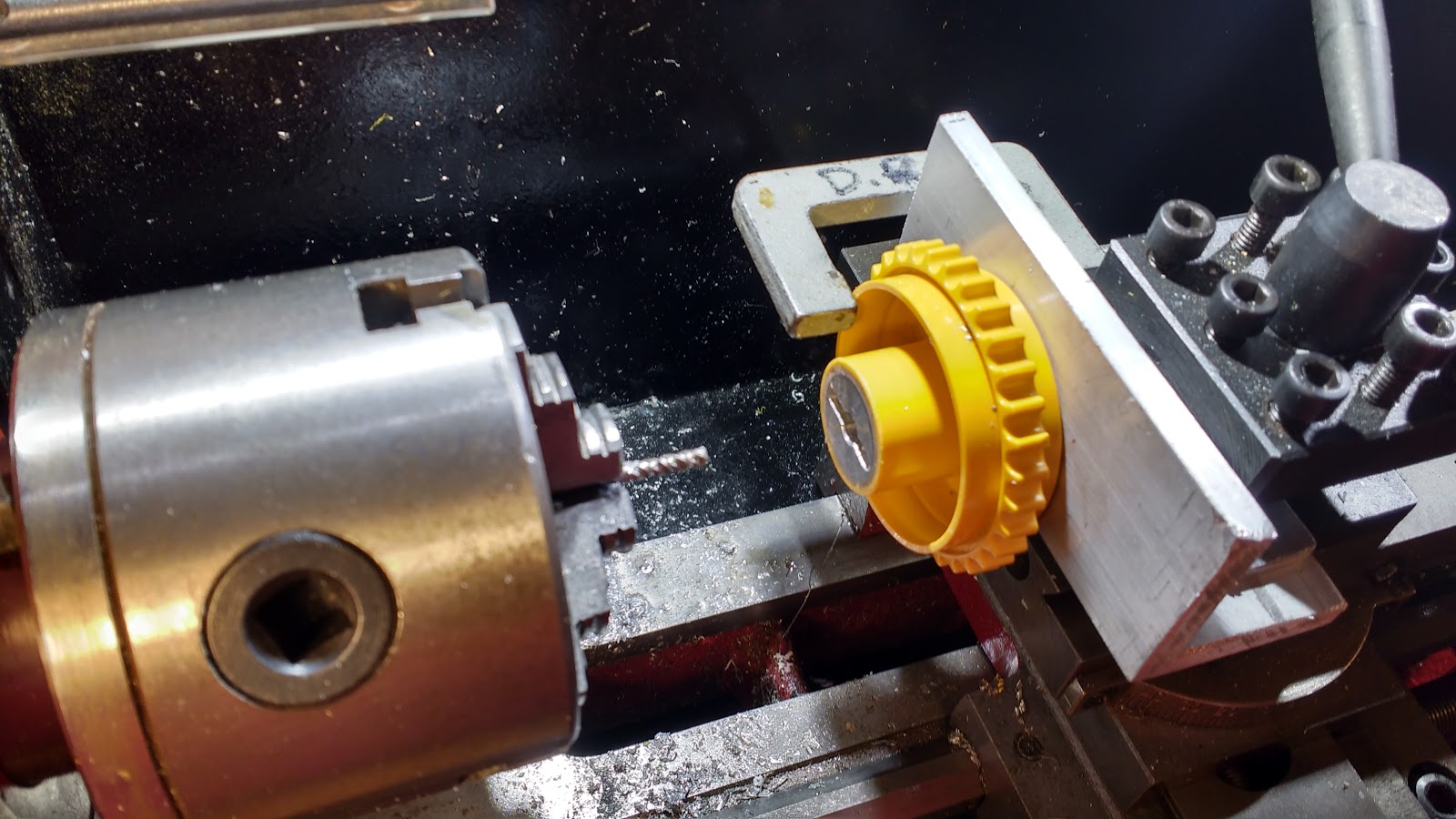
The next drive train job to tackle was the drive sprockets onto the motor gearbox shafts. Conveniently the output shaft on the motors has a M3 tapped hole in the end and a 3mm hole in the shaft to take a pin. I just had to machine a hub with a slot to engage with the pin. I had already made the hubs using some aluminium rod and glued them into the plastic sprocket wheel with thin super glue and baking soda to fill the gaps. It was after this I came up with the idea to mill some pin slots, so I needed a way to hold the sprocket in the tool post of the mini lathe spinning a 3mm endmill in the 3 jaw and use the cross slide to move the workpiece, like a poor mans milling machine.


 I cut a piece of thick aluminium angle and clamped it in the tool post. Then with a 2.5mm drill in the 3 jaw chuck, moved the carriage forward thus drilling a hole at the exact centre height of the chuck. This was then tapped M3 and the sprocket bolted in position through a pre drilled 3mm hole in the hub. The hub also has a 6mm hole that only goes about halfway in which is the size of the output shaft on the gear motor. With a tiny clamp stopping any rotation the slot was gingerly cut from the centre out in both directions a millimeter deep at a time for a total depth of 3mm.
This slot engages with a pin in the shaft locating it radially and axially at the correct track centre distance and the sprocket is retained with a 3mm cap screw into the the threaded portion at the end of the shaft.

Of course it would have been sensible to cut the slot before gluing the hub into the plastic sprocket but when you are working this stuff out as you go along sometimes the penny drops a bit later than would have been ideal.

I have yet to wire up the motors for a preliminary test but so far it all looks like it will work.

Now with all the major mechanical issues addressed what does the vehicle itself look like, well here it is so far...


I was originally thinking of using the Wall E cab but remembered I had a 1/25 scale truck cab lying around which I think looked a lot more interesting when combined with the digging tooth from the Bruder dozer. The cab section is held on with some screws so it can be removed and worked on separately.
Some acrylic plastic wine glasses from a charity shop are being used as tanks at the rear, covered with a plethora of pipes and kit part detailing. The whole rear tank module is removable (held on with a couple of cap screws into some more superglued PVC sheet drilled and tapped M3) so the motor mount can be extracted for servicing if necessary.


I thought the arms at the side of the Wall E truck which held some wacky tractor wheels could be re-purposed for some laser like devices making this some kind of laser mining vehicle. I had a Nerf gun toy that might fit the bill for this and found another one new for only $7.00 at Target for the other side. I removed the handle which is conveniently a separate part.


Various holes in the body have been filled with styrene strip and detailing of the surfaces has begun.


More soon...

Tuesday, 18 August 2015

Motor per wheel test rig

To test out my idea of one geared motor per wheel in a spin steer vehicle I built a quick chassis out of wood.
The purpose was to test whether the speed controllers ( dual Traxxas EVX) could handle the load and if the gear ratio was suitable for different sized tyres.
The motors are the cheapest  I could find on ebay from China. They are brushed 12 volt 540 can motors with an inline gearbox supposed to run at 500 rpm unloaded. The output shaft is 6mm and runs on a plain bearing.
I had previously estimated that 400 rpm would be about the right top speed required by bolting a wheel to my cordless drill which has a 2 speed gearbox. The lowest speed is 400 rpm and that seemed about right as i ran it along the ground. I decided that perhaps a bit extra might be required so I purchased the 500 rpm units.
There is no suspension at all, with each motor /gearbox unit strapped into some circular holes in the frame.
Each EVX controller is hooked up to the three motors per side in parallel.
One of the controllers has its red wire removed from the receiver plug so only one BEC is being fed to the receiver.
I had already tested the current draw of the motors which is less than 2 amps no load and just over 4 amps loaded, so the EVX speed controllers should be more than capable of handling at least 4 of these motor/gearboxes.

I  first tested a set of Axial oversized beadlock wheels (3.8)  with Losi ATX 420 tyres, followed by Imex Jumbo Maxx Chevrons which are a slightly smaller circumference. I then bolted on some massive RC4WD Interco Super Swamper 40 series TSL/Bogger scale tyres mounted to my homemade PVC wheels, click the link to read the post- Giant-tyres-and-pvc-wheels


I used my Turnigy 9X radio that I modified to have a return spring on both sticks. Push both sticks forward for straight running. To turn you pull one stick back to brake that side. The EVX speed controllers have a brake system so the stick has to be brought back to brake, then returned to neutral and brought back again to get reverse. This is not ideal, instant reverse would be preferable ( at the cost of potentially tearing up the gearbox) but despite this it does work and you get used to controlling it this way. A gentle tap on the brake on one side gives you a gentle turn. Further manipulation of the sticks allows the full spin steer where one side is in forward and the other reverse spinning the vehicle on the spot.


I also added a Life battery and added a Smarty Pants board to replace the firmware with Open TX.


The losi ATX 420 tyres mounted to Axial Oversized beadlocks required some grinding of the bead to fit well. The Axial beadlocks have a wedge shaped receptacle for the bead whereas the tyres have a rectangular bead. The inner edge needs to be chamfered. A sanding drum in the drill press did the trick.


I like these tyres, they are relatively cheap, grippy, seem to be able to cope with on and off road and make a great tyre squeal sound when rubbed along the floor. As a bonus they look very SCI FI.


The Imex Jumbo Maxx wheels were attached to the 6mm gearbox shafts with some modified 14mm hex wheel wideners. I tapped the hole for the axle pin for a M4 grub screw. I wish I could find shorter versions as they really dont need to stick out so far, in fact there would be less sideways load on the plaiin bearing if it wasnt so long.


The Axial beadlocks were attached with some modified Traxxas 17mm hexes which were drilled out 6mm for their whole length to fit over the shafts. This is much better as it is close to the bearing.
A ball bearing supported shaft would be much better mechanically here, but a quantity of quality motors and gearboxes is way outside my budget.

The Bogger/PVC wheels used the same Traxxas 17mm hexes.


Here you can see the Losi 420 tyres against the Boggers. I still cant get over how bloody enormous they are. They are also very a very heavy mass to rotate.
The Losi 420 tyres have a circumference of 564mm whereas the Boggers are 793mm, that is 1.4 times more. It means that the gearbox should be geared down by that amount. I figured that 500 rpm probably would be a poor match for these wheels.


The results of testing showed that for the Imex Jumbo maxx and the Losi 420 tyres 500 rpm gearbox is about correct for a bashing style of driving. I think my first estimate of 400rpm would be better for a more controlled style that I am after for these SCI FI vehicles which are not really about speed. Even with these 500 rpm gearboxes the speed controllers and the motors barely got warm, so I have no fears about adding and extra motor per side for an 8X8.

With the Boggers the motors did manage to turn the wheels but, as predicted, the motors got very hot quickly. If 400 rpm suits the 420 tyres then 0.7 times 400 which is 280 rpm should suit the Boggers.
You can get 200 rpm or 300rpm gearboxes so depending on whether you choose speed  or torque you could go either way.
I will probably go 200 rpm as I'm after climbing ability over speed.
Given that I have the 500rpm motors I will use them for a 6X6 I have planned and have a couple of spares.

More soon...


Most Popular Posts in the Last 7 Days