About this Blog

This is about the combination of two interests, Radio Control vehicles and Science Fiction models. This blog documents my science fiction spaceship and radio controlled vehicle projects.

Saturday, 25 November 2023

Film Can Spaceship part 3

 Next task was detailing the backplate of the engines. The inner nozzles are made from the rims of a rubbish truck toy with outer rings made from the screw on caps of pop-up sprinklers. The inner thread of the sprinkler has been machined away on the mini lathe.


 Followed up with a hit of grey primer to check the result.


I then moved on to detailing of the top sides of the film cans with 1mm and 2mm plates of styrene sheet arranged around the 3D printing filament reel sides. I then added some scribed panels and a sprinkling of kit parts.


After finishing the top section of both cans I sprayed one with primer to check, was satisfied with the result and  sprayed the second can.


Progressing on from that I turned the cans over to detail the undersides. Here I followed the same procedure except that after spraying the first can with primer I felt a little more detail was required so scraped and sanded away the primer in the spots I wanted to add more nurnies. This I did to both cans and then sprayed primer once again over the new nurnies to check and then repeated the primer application on the second can.


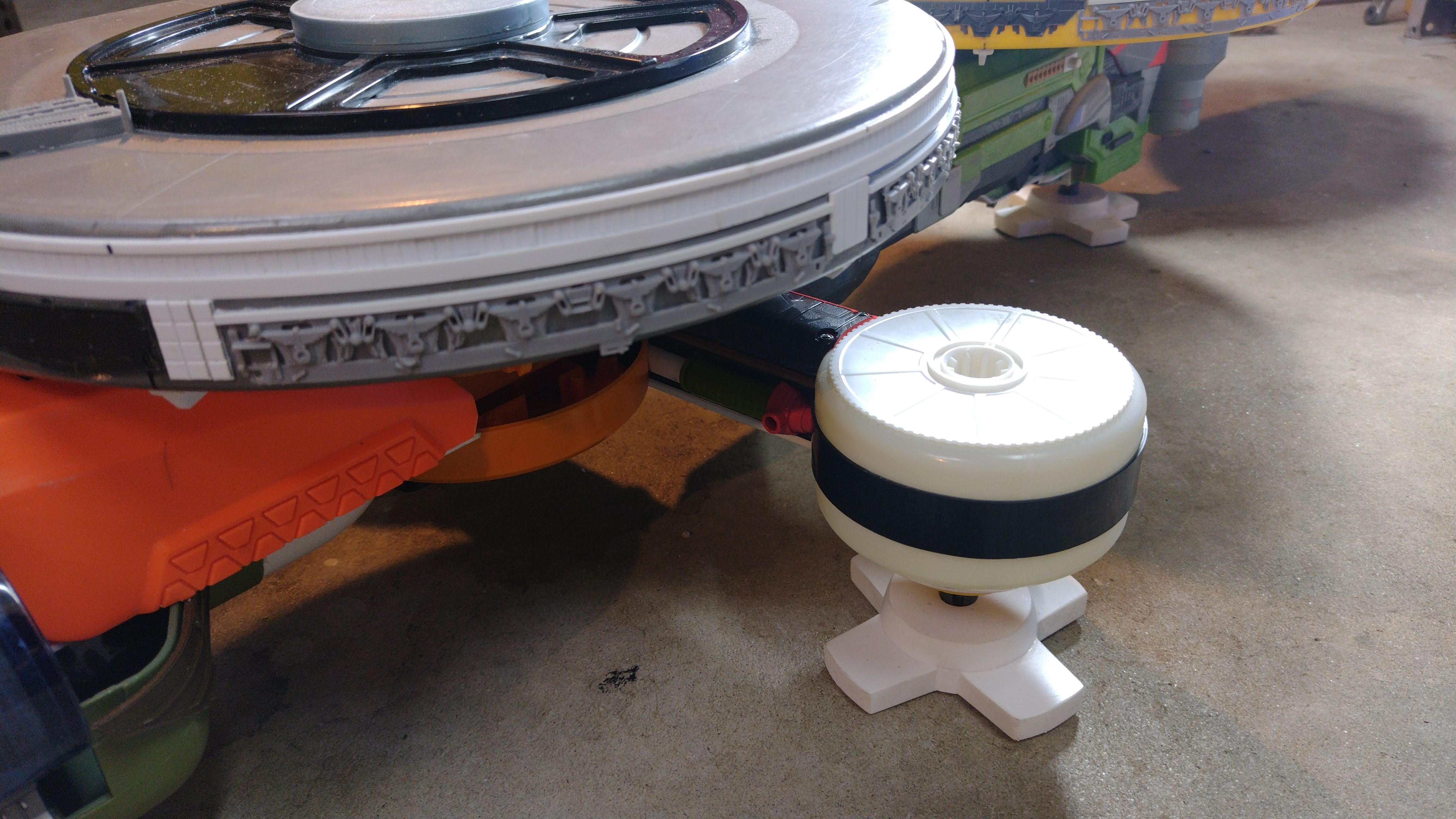
I then decided to detail the landing pads. They were removed by pushing out the brass tube pin. Evergreen textured sheet was used along with some tank trackshoes. The top details are the wheels from the Tamiya 1/35 scale British 25 pounder field gun kit. I cut the spokes to remove the wheel hub.


 Next it was on to completing the detailing on the engine pod and the rest of the long skinny Nerf gun hull section. The picture below shows the finished top of the engine section.

Below is the underneath of the engine section.

Rear landing pod cross beam top followed by underside. The piping is a mix of solid ABS rod heat bent, for the larger diameters and single strand solid core electrical wiring.


Then a few photos of the rest of the Nerf Nitron hull finishing with the front panel kit part detailing.


The next logical step was to check the result of all that work with... you guessed it... some grey primer.

I sprayed the primer with an outside temperature of 38.6 degrees celsius.  It did not take very long to dry. We are in the midst of a record breaking heatwave at the moment.


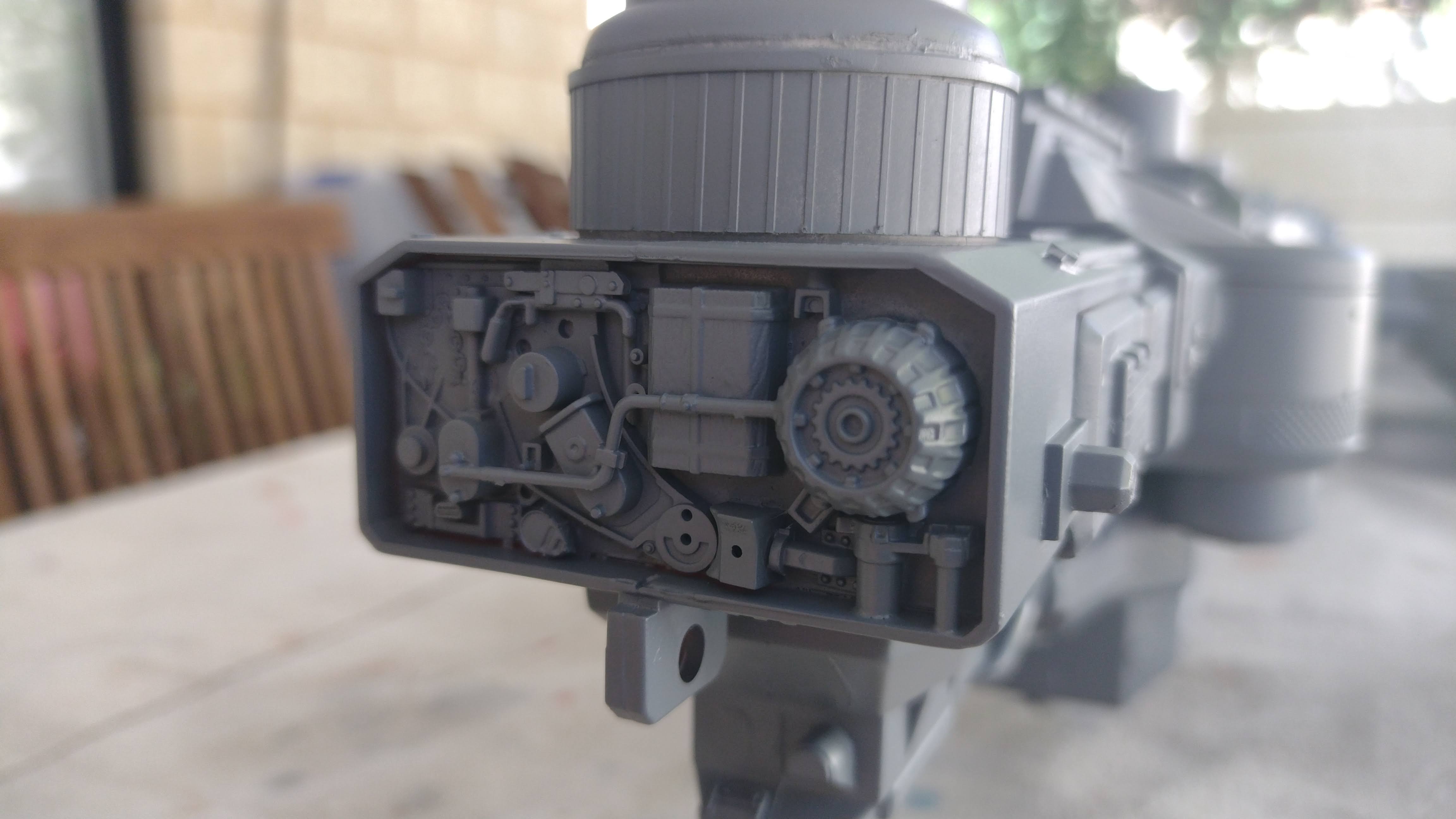
A lot of the top of the Nerf hull is going to be covered by the film cans and bridge section so I deliberately left the detailing fairly crude as you will only see it side on and predominantly in shadow.

I am going to hold off final assembly till after paint as it is going to be a lot simpler masking and painting the separate sections before mounting them permanently.

Thanks for looking.

More soon...

Sunday, 12 November 2023

Tank Hull Spaceship part1

In the middle of detailing the film can spaceship I had an idea about trying to build a spaceship model using tank kit hulls for the main structure from the large stash I have stored in a couple of plastic containers. 


The green container for the bottom hulls on the right is about twice as big as the one for the tank tops as the tank tops are more useful as large areas of detail and I find myself using them more often in projects than the tank bottom hulls. 

Of course I had to try it out and therefore started another new project the result of which can be seen below.
The structure is built on a length of pine to which I have attached a couple of 15mm water pipe flanges for mounting in exactly the same way as the film can spaceship. All the 1/35 scale tank hulls are strung along this wooden spine using 2mm styrene sheet bulkheads and connecting panels.


The bridge section is made from two Stryker kits of different types. I have detailed the interior and made windows from 2mm acrylic sheet. It is lit in the usual way with a led light strip consisting of the shortest possible module of 3 leds at 12 volts. The bridge top is removable for access.


 The neck is made from two gun turrets from Tamiya Flakpanzer Gepard kits followed by two Dragon Jagpanzer top hulls top and bottom with two cut down Dragon Maus bottom hulls on the side.

The middle section is a combination of two Italeri DUCW amphibious upper hulls and two lower LVT amphibious hulls on the sides. Added to each side is a Maus turret.

The rear engine section is made up from two Geppard hull tops and two Hobby Boss Land Wasser Schlepper amphibious vehicle lower hulls on the sides. I used the Land Wasser cockpits on two previous projects, the Science Vessel project and the Heavy Salvage Tug. One of the Land Wasser hulls has some nice raised line detail on the bottom of the hull and strangely the other doesn't. They both came with the same box art but were purchased a couple of years apart.


For the engines, I am going to use a number of LED garden lights I obtained cheaply as they were being discontinued at my local Bunnings hardware store. They have a convenient bell nozzle shape and I have used them before on my Escape pod mark II project. They are not particularly bright but will do for this project.


The bridge section is yet to have window mullions added to break up the large areas of glass. I will also add some 1/72 scale figures to the interior. 


 The model currently measures 885mm long with the engine nozzles still to be added.

Thanks for looking.

More soon...


Monday, 28 August 2023

Film Can Spaceship part 2

 As I am currently unemployed I have been able to put in a lot of build time on this project. 

I realise that I have not shown the general layout of the whole model, so to rectify that omission here it is in its full length with all the major sub-assemblies in place.


One of the jobs I tackled was the landing pads. The pads themselves are made from two layers of 10mm foamed PVC sheet. The bottom layer was designed in LibreCAD and printed out full size on paper which was then glued to the PVC with UHU stick glue and cut out on the bandsaw.


.A disc was then cut out of the same material on the drill press (at the lowest speed) and then sanded on the disc sander with the table set to roughly 10 degrees to make the edge slightly tapered.


The discs were then drilled out to 1/2" superglued to the base plates and some Evergreen 1/3" tile textured sheet glued to the underside.


I then made a connecting piece from 1/2" solid PVC rod which is press fit into the pad and hooked up to the spring landing strut with a pin made from a short length of brass tube.

I also started detailing the rear landing cross beam. On the top surface I used the cut-off front grip from the Nerf Nitron. Underneath I used some classic kit parts form the Hasegawa 1/72 Leopold which can be seen all over the 1978 Battlestar Galactica studio miniatures. A bunch of piping was added using solid ABS rod bent using a heat gun and some made from single solid core electrical wiring.


 The blue part seen in the picture above is a dial from a washing machine. One other interesting part I used which you can see on the top of the landing pods is the white plastic reels from inside an old VHS video tape.


I have placed a 1/72 figure next to the pad to show the scale. The model has turned out to be reasonably lengthy and measures 1290mm long which if you divide by 25.4 will give you inches, so nearly 51 inches or 4 feet 3 inches.

The other major construction was the film cans themselves. They have been raised up to make them thicker by about 12mm. The tops have the addition of the cut off  sides from 3D printing filament reel with the centre cap of an old vacuum cleaner's wheels added on top.


I have also detailed the sides of the film cans with more still to be done on the top and bottom surfaces.


Other areas have begun to receive detailing here and there with a start made on the engine pod.


Thanks for looking.

More soon...


Most Popular Posts in the Last 7 Days