About this Blog

This is about the combination of two interests, Radio Control vehicles and Science Fiction models. This blog documents my science fiction spaceship and radio controlled vehicle projects.
Showing posts with label David Tremont. Show all posts

Monday, 8 February 2021

Ultraman Towards the Future AKA Ultraman Great part 13

Quite a lot of the miniatures in Ultraman Towards the Future experienced some form of pyrotechnics or other as evidenced by previous posts. This is a selection of other things that went bang.


Here I am, hammer in hand, making a modification to a breakaway structure on top of one of the buildings originally made for the aborted 1987 Total Recall movie which the Ultraman production acquired.  Steve Newman the DOP is on the right and Paul Nicola visual effects supervisor looking through the second camera bottom left.


I added the small structure at the very top which was meant to be some sort of service equipment. It had a series of corrugated aluminium panels made from fin stock surrounding a small tank structure and random nurnies all lightly glued together to come apart easily on impact.


The action was as you see here a glancing blow from a UMA Hummer which was thrown off course due to the extreme halitosis effect of the monster.


On the off camera side of the building was an electronic motion sensor that triggered the pyro as the Hummer sailed past. The Pyro effect was by Alan Maxwell. I believe it was napthalene flakes added to the black powder that provided the red rolling fireball and oily black smoke.


In the pictures below you can see the motion sensor and its wiring taped to the right side of the building model. The cameras were placed on the left side of this photo.


This sequence featured another Total Recall building that was modified with a ground floor shop. Hanging above the shop-front awning was a large scale monster foot filled with lead weights. The ground floor shop and its contents were built by David Tremont. Scale is 1/24th.


The foot was dropped and the pyro ensues. In the rushes the next day, the footage from the Photosonics Actionmaster camera at 500 Frames per second was pretty spectacular. The miniature shop was filled with various tiny model furniture items and a table and chairs could be seen flying out the window towards camera through the fireball. You rarely get to see all that action in the episodes as the pyro shots in the show usually cut away quite quickly. In the shot as it appears in the episode, you do see the table starting to come out of the fireball but it cuts before you see a chair.


TThe picture below shows the aftermath. Paul Nicola the visual effects supervisor with yellow face shield is standing behind the Arri SRII along with Joanne Parker the camera assistant. The Photosonics Actionmaster camera is on the right. Alan Maxwell responsible for the pyro effects is behind the scaffold at the back.


Here, I am in the middle of assembling a 1/25 Italeri tanker truck plastic model kit that was later filled with a sequenced pyro effect for a shot of it exploding. It was a one take affair as there was no time for making another one. As it happened the Photosonics Actionmaster camera, which was the hero camera angle, jammed right on the cue to fire the pyro and we only got the shot from the alternative camera angle covered by the ultra reliable Arri SRII at 250 frames per second. A small joke in this photo is the little jimmy figure with his head in the vice. 


 Thanks for looking,

More soon.


Saturday, 30 January 2021

Ultraman Towards the Future AKA Ultraman Great part 11

 Martian Landscape

The martian landscape was another set built by Tony Lees.


The Martian Lander spacecraft started as another one of my own personal spaceship projects which was donated to the production and completed by David Tremont with the addition of the communications pod and the final paint finish.


This was my original Lander project in primer before it was modified for the Ultraman production. The engine nozzles were from a Revell 1/72 space shuttle kit. I was inspired by a mushroom shaped ship I saw in a small photo in an issue of Cinefantastique magazine.


David Tremont on the set with the completed lander- seemingly asleep.


The Goudis puppet in its original form made by the puppet crew Steve Roswell, Vicki Kite, Graham Binding, Norman Yeend and Warren Beaton. It was one of the puppet creatures that eventually got re-made as a man in a suit for a fight sequence with a man in a suit Ultraman.


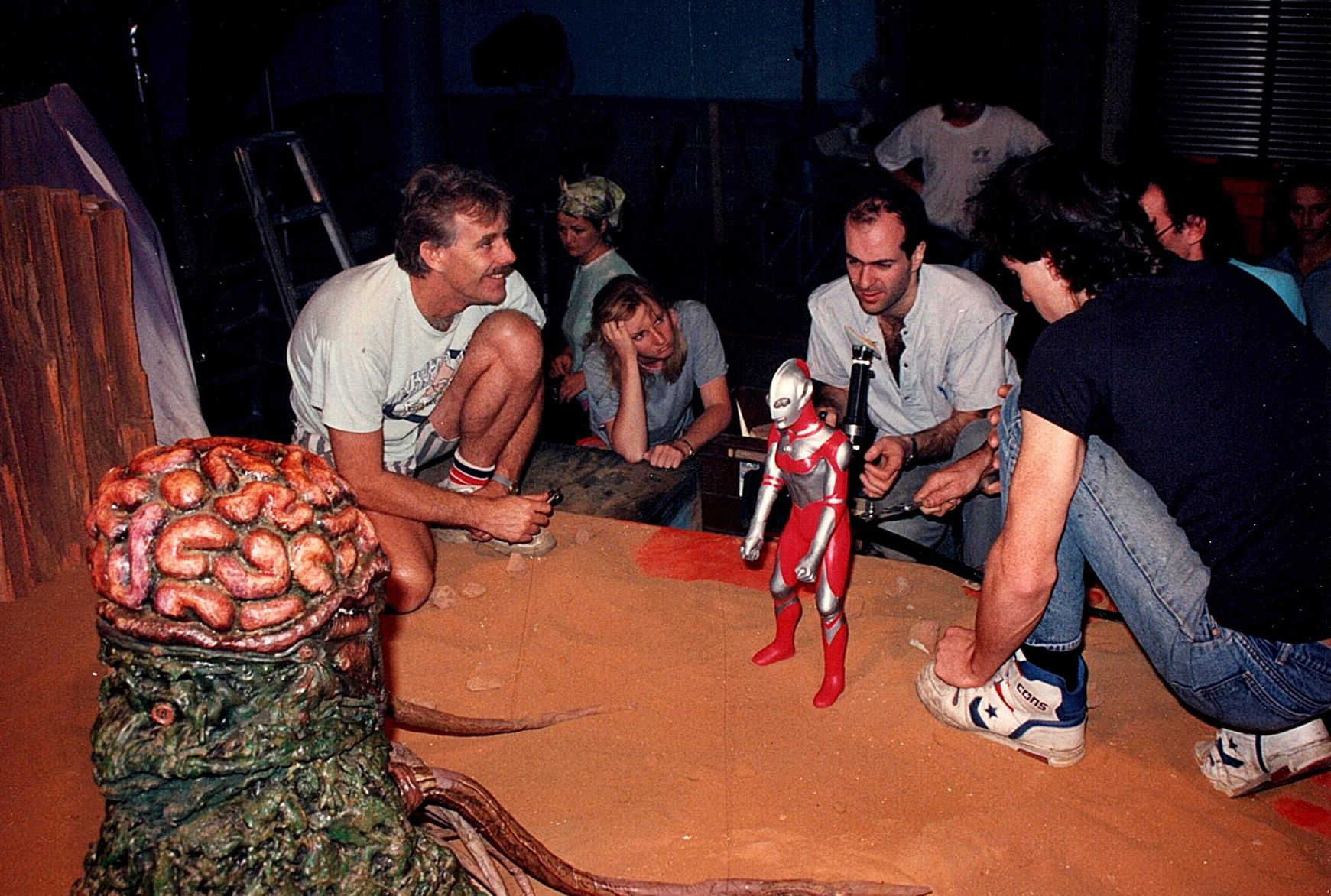
The cable controlled Ultraman puppet built by Warren Beaton squares off against the puppet Goudis. It was a very hot summer during the shoot and to get the depth of field for the high frame rate shots they needed a lot of light. The sun light was provided by a large Dino light, nine globes in a panel that gave of a massive amount of heat raising the temperature of the sand on the set above 55 degrees celsius (131 farenheit). There were two portable air conditioners running that failed to make any dent in the temperature in the studio. Walking into the studio from the workshop was a real shock to the system.

Goudis and Ultraman with foreground left to right, Jaimie Crooks the First AD, Joanne Parker camera assistant, Paul Nichola Visual Effects supervisor, Steve Roswell and behind him Paul Moyes miniatures unit gaffer. The people in the background I am not sure about.


Paul Nichola the Miniature Effects supervisor looking down the eyepiece as Adam Newcombe manipulates the Ultraman puppet.


This was the workshop area with the puppet crew occupying the right side corner. Visible in the picture left to right are, actually I'm not sure who that is on the far left, then Vicki Kite, Steve Roswell and Norman Yeend.


This was the model makers side of the room. From left to right are David Tremont, Adam Grace and me.


Saturday, 9 January 2021

Ultraman Towards the Future AKA Ultraman Great part 9

One Ultraman episode was filmed at an RAAF Air force base and we had to match the hangar in miniature. It was also a further outing for our contingent of FA18 models in 1/48 and 1/32 scale.


Miniature aircraft Hangar model 1/48 scale FA18 models parked out the front with the UF-O creature hovering above. In the background is a warehouse model built for a previous episode with no roof. The lack of roof was not visible from the low camera angle. Unfortunately I can't recall who built the hangar model.


In the episode the UF-O creature breaks out of the hangar by punching through the roof. The bent out roof panels were made from the same thick aluminium foil known as "fin stock" as used for the blasted rock walls of the under ground UMA base. The aluminium panels were pressed between two Evergreen textured styrene sheets to impart the same corrugations as on the rest of the model.


Here I am attempting to superglue the Evergreen styrene roof panels down which expanded and buckled under the heat of the studio lights. The foreground FA18 model is 1/32 scale with the 1/48 scale models behind.


Of course the UF-O creature causes havoc. One of the 1/32 scale models is trashed. Pyro effects were by Alan Maxwell assisted by Judy Dabbs.


The aftermath of the explosion. You can see the specks of black soot on the foreground aircraft model that would pepper everything in the vicinity of the pyro. It would all have to be cleaned off for use in another shot. Models tended to get dirtier and dirtier as the model shoot progressed.


A second 1/32 scale model about to take one for the team. You can see that the model has been pre-broken and loosely put back together so that the explosion will split the back of the aircraft flipping both halves apart. You never see the obvious break as in the edit the shot will usually start right at the point of the pyro detonating.


There was a shot of the UF-O breaking through the roof from the inside of the hangar so a special breakaway interior roof section miniature was built by David Tremont. It was a very fragile structure that was placed upside down so the UF-O model could be dropped through the structure.


With the camera mounted upside down it would appear that the UF-O was rising up through the roof. The picture below shows the shot being set up with Steve Newman the model unit DOP on the left and David Tremont in the back. I think it may be Philip Hearnshaw the second unit director on the right.
As usual there were two high speed cameras filming the action, the Arri SR II on the left and the Photosonics Actionmaster on the right.


  This is roughly how the scene would look through the camera. The curved trusses were cast from a silicon mold in a brittle resin that would break easily as the UF-O was dropped through them. All the broken debris would obviously travel "upwards" relative to the camera with none of it "falling" back down. The shot is so quick that there is no time to notice that it seems to defy physics.


 As with almost all the models built for the show the hangar exterior model gets re-used and makes an appearance in the Gigasaurus episode as some sort of industrial building. In this photo you can see its outline and the unpainted chipboard back wall that was never seen on camera.


 Here it is with a number of small diecast toy cars parked outside.


 Here I am spraying Santa Snow over the scene to show the effects of Gigasaurus' freezing breath. Paul Moyes the model unit gaffer looks on.


Thanks for looking, more soon.

Ultraman Towards the Future AKA Ultraman Great part 8

 We had a range of aircraft models that were featured in the show.

A couple of episodes of Ultraman featured the RAAF ( Royal Australian Air Force) as attacking aircraft in the air and on the ground. In 1989 the RAAF was flying FA18 aircraft, now more than 30 years later they still are. We built up a number of plastic model kits of the FA18 in 1/32 and 1/48 scale. Below is is one of the larger 1/32 scale models used for closeups and pyro.


 The larger 1/32 models in flying mode were mostly mounted by clamping a wing in a C-stand just out of frame, as they were usually used for close ups


In the two pictures above one of them meets a fiery demise due to some creatures malevolent intent. The model was covered in a pyrotechnic material and ignited with an electric igniter. A fan was placed further back and below to blow all the pyro smoke back and look like the aircraft was in flight.


For a quick scene of the FA18s parked at a base a small set was cobbled together from some UMA base service equipment, cocnut matting hills and model building bits we had on hand. The foreground plane is 1/32 and the rest are 1/48 scale.


Here I am watching Adam Grace peruse the instruction sheet to figure out the decal placement on the completed 1/48 scale kits. All the kits came with RAAF markings which was handy for us. I think we may have added an UMA triangle decal to the centre of the RAAF roundel which covered the kangaroo.


This shows a flight of 1/48 scale kits on their wire rig. Sometimes they were hung from a converted TV microphone boom and swung in an arc. In this case when they were in formation they were hung from a simple wooden rig that was attached to a cable that traveled across the studio in a straight line.

On the left is Hisashi Ogasawara who was the Tsubaraya productions wire specialist sent out from Japan. He was always referred to by the Japanese supervisor Koichi Takano as his nickname, which we were told translated as "Turtle". His credit on the show was "Manipulator". Our Japanese translator is assisting (right) unfortunately I don't remember his name. 


Visible in the picture above is Hisashi Ogasawara's winding mechanism brought out from Japan that moved the flight of aircraft models along the cable across the studio. It is a modified Film rewind handle with an aluminium pulley with three different diameter pulley grooves machined into it. The three different diameter grooves allowed for three variations in gearing allowing a wide range of speeds. It is mounted to a wooden base that is held down by a couple of heavy weights. As the pulley wheel was wound by hand the formation of aircraft would travel across the studio.


Martin Williams (standby props) attending to the wires. You can see the simple wooden marionette handle the models are suspended from which in turn attached to the cable that was wound across the studio. Above and behind him is the end of the boom arm that provided a curved trajectory for the models. Because the models on the boom appear to turn, a small slow speed geared 12 volt motor provided a banking motion as the boom was swung. This was controlled by a simple switch mechanism that provided forward and reverse direction to the motor which effected left and right roll of the model. Each model was supported by a thin tungsten wire at the nose and the tail with two more wires going to each wing tip which wrapped around the banking motor pulley.


David Tremont built a large scale missile for a close up launching shot. 1/32 scale FA18 models on the bench. There is also a tiny hummer model on the bench next to a kit missile that he was matching in the larger size.

Above is the modified TV microphone boom arm in use flying the UF-O creature.

 One of the smaller hummer models hung from the boom arm.


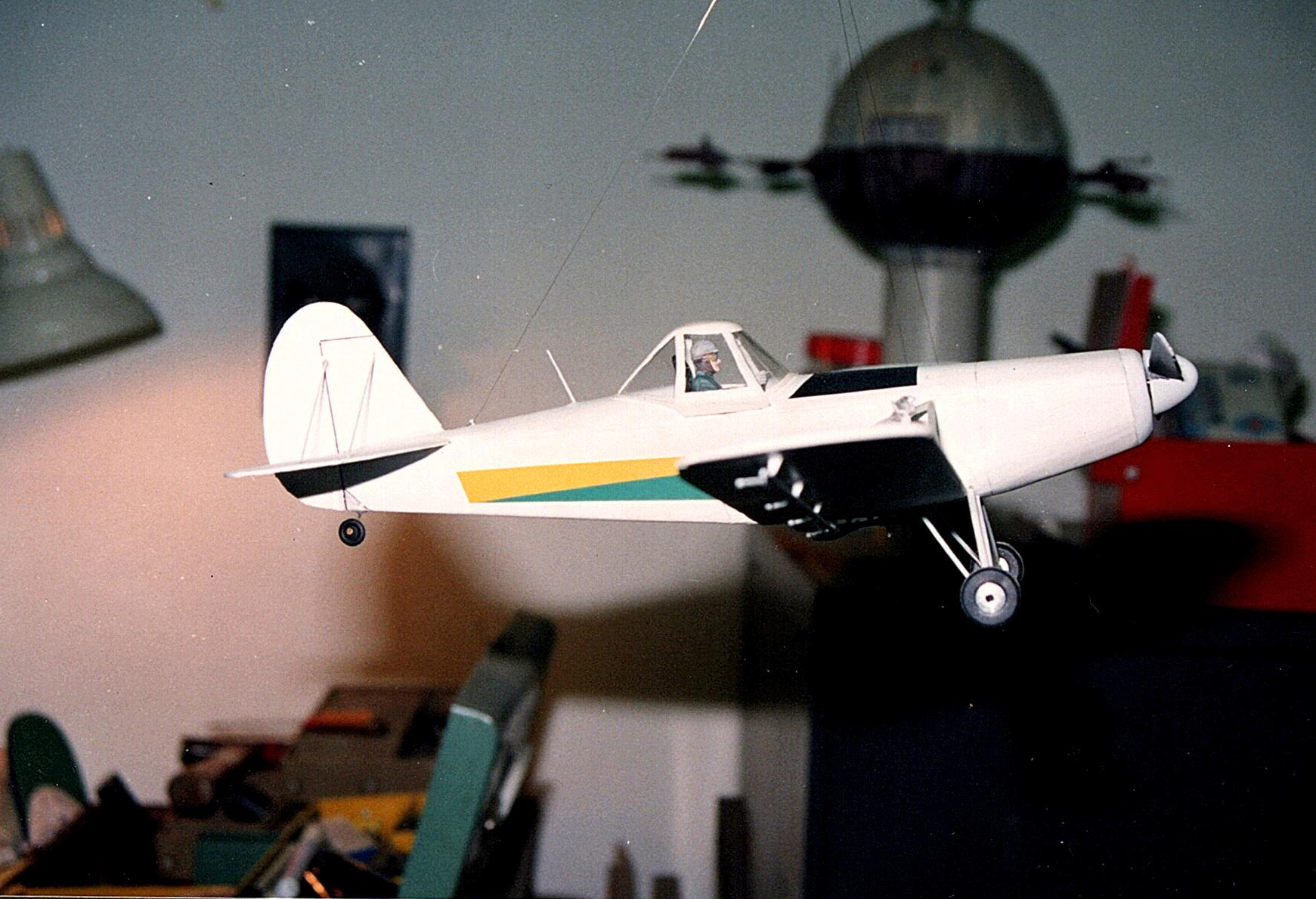
In one episode a full size crop duster aircraft is featured. I made up a small balsa kit of the aircraft to match the full size.

It had a small electric motor and a battery inside to spin the prop.It was only ever seen at a distance so was fairly simply detailed with some crop spraying pipes and nozzles under the wing as well as a matching livery to the full size aircraft.


In the photo above I am switching on the electric motor prior to the shot with Jaime Crooks the First AD (left).


For another episode a military General arrives at UMA base to chew everybody out in an eye bulging display of over the top acting and we needed a quick shot set up of his aircraft arriving. We used a few bits of the UMA base set and one of my own personal kit bashed aircraft projects for the scene. The only thing done to the aircraft model was to add some RAAF markings with an UMA triangle decal. As I remember the kit bash used two Airfix Vulcan kits joined to a B1 bomber nose and fuselage. The outer wing tips were from a Skyray. In the shot the aircraft is slowly rotating on the turntable as if it just landed. You can also see one of the 12 volt Phillips halogen miniature bayonet lamps mounted on the ground under the rear of the aircraft. This provided a bright flaring backlight, I think to represent landing lights, but mostly to add a bit of interest to a quickly cobbled together shot.
 
I never got that model back and have no idea what happened to it. I fact I never got any of my donated models back.


Most Popular Posts in the Last 7 Days