About this Blog

This is about the combination of two interests, Radio Control vehicles and Science Fiction models. This blog documents my science fiction spaceship and radio controlled vehicle projects.
Showing posts with label Adam Grace. Show all posts

Saturday, 30 January 2021

Ultraman Towards the Future AKA Ultraman Great part 11

 Martian Landscape

The martian landscape was another set built by Tony Lees.


The Martian Lander spacecraft started as another one of my own personal spaceship projects which was donated to the production and completed by David Tremont with the addition of the communications pod and the final paint finish.


This was my original Lander project in primer before it was modified for the Ultraman production. The engine nozzles were from a Revell 1/72 space shuttle kit. I was inspired by a mushroom shaped ship I saw in a small photo in an issue of Cinefantastique magazine.


David Tremont on the set with the completed lander- seemingly asleep.


The Goudis puppet in its original form made by the puppet crew Steve Roswell, Vicki Kite, Graham Binding, Norman Yeend and Warren Beaton. It was one of the puppet creatures that eventually got re-made as a man in a suit for a fight sequence with a man in a suit Ultraman.


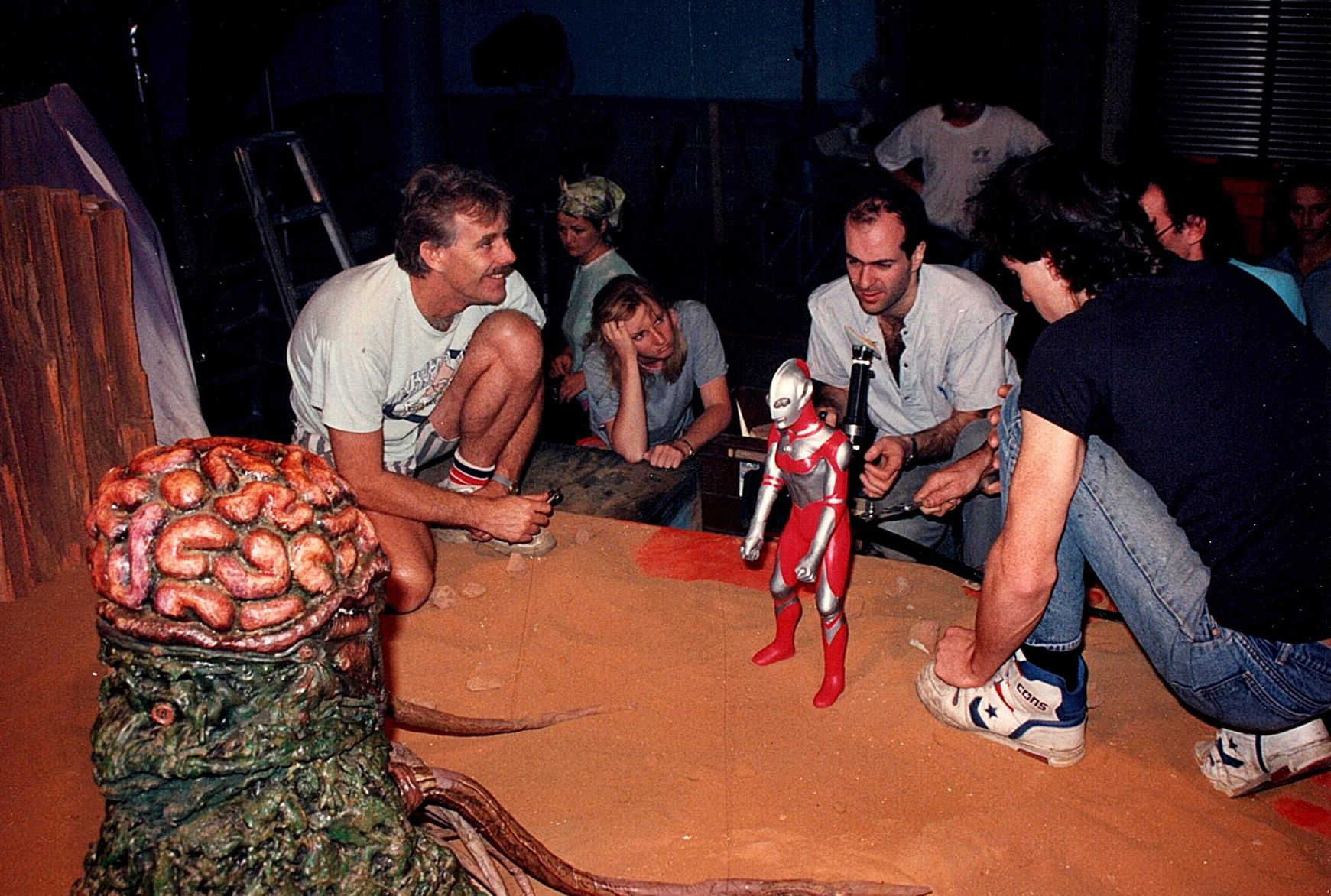
The cable controlled Ultraman puppet built by Warren Beaton squares off against the puppet Goudis. It was a very hot summer during the shoot and to get the depth of field for the high frame rate shots they needed a lot of light. The sun light was provided by a large Dino light, nine globes in a panel that gave of a massive amount of heat raising the temperature of the sand on the set above 55 degrees celsius (131 farenheit). There were two portable air conditioners running that failed to make any dent in the temperature in the studio. Walking into the studio from the workshop was a real shock to the system.

Goudis and Ultraman with foreground left to right, Jaimie Crooks the First AD, Joanne Parker camera assistant, Paul Nichola Visual Effects supervisor, Steve Roswell and behind him Paul Moyes miniatures unit gaffer. The people in the background I am not sure about.


Paul Nichola the Miniature Effects supervisor looking down the eyepiece as Adam Newcombe manipulates the Ultraman puppet.


This was the workshop area with the puppet crew occupying the right side corner. Visible in the picture left to right are, actually I'm not sure who that is on the far left, then Vicki Kite, Steve Roswell and Norman Yeend.


This was the model makers side of the room. From left to right are David Tremont, Adam Grace and me.


Saturday, 9 January 2021

Ultraman Towards the Future AKA Ultraman Great part 8

 We had a range of aircraft models that were featured in the show.

A couple of episodes of Ultraman featured the RAAF ( Royal Australian Air Force) as attacking aircraft in the air and on the ground. In 1989 the RAAF was flying FA18 aircraft, now more than 30 years later they still are. We built up a number of plastic model kits of the FA18 in 1/32 and 1/48 scale. Below is is one of the larger 1/32 scale models used for closeups and pyro.


 The larger 1/32 models in flying mode were mostly mounted by clamping a wing in a C-stand just out of frame, as they were usually used for close ups


In the two pictures above one of them meets a fiery demise due to some creatures malevolent intent. The model was covered in a pyrotechnic material and ignited with an electric igniter. A fan was placed further back and below to blow all the pyro smoke back and look like the aircraft was in flight.


For a quick scene of the FA18s parked at a base a small set was cobbled together from some UMA base service equipment, cocnut matting hills and model building bits we had on hand. The foreground plane is 1/32 and the rest are 1/48 scale.


Here I am watching Adam Grace peruse the instruction sheet to figure out the decal placement on the completed 1/48 scale kits. All the kits came with RAAF markings which was handy for us. I think we may have added an UMA triangle decal to the centre of the RAAF roundel which covered the kangaroo.


This shows a flight of 1/48 scale kits on their wire rig. Sometimes they were hung from a converted TV microphone boom and swung in an arc. In this case when they were in formation they were hung from a simple wooden rig that was attached to a cable that traveled across the studio in a straight line.

On the left is Hisashi Ogasawara who was the Tsubaraya productions wire specialist sent out from Japan. He was always referred to by the Japanese supervisor Koichi Takano as his nickname, which we were told translated as "Turtle". His credit on the show was "Manipulator". Our Japanese translator is assisting (right) unfortunately I don't remember his name. 


Visible in the picture above is Hisashi Ogasawara's winding mechanism brought out from Japan that moved the flight of aircraft models along the cable across the studio. It is a modified Film rewind handle with an aluminium pulley with three different diameter pulley grooves machined into it. The three different diameter grooves allowed for three variations in gearing allowing a wide range of speeds. It is mounted to a wooden base that is held down by a couple of heavy weights. As the pulley wheel was wound by hand the formation of aircraft would travel across the studio.


Martin Williams (standby props) attending to the wires. You can see the simple wooden marionette handle the models are suspended from which in turn attached to the cable that was wound across the studio. Above and behind him is the end of the boom arm that provided a curved trajectory for the models. Because the models on the boom appear to turn, a small slow speed geared 12 volt motor provided a banking motion as the boom was swung. This was controlled by a simple switch mechanism that provided forward and reverse direction to the motor which effected left and right roll of the model. Each model was supported by a thin tungsten wire at the nose and the tail with two more wires going to each wing tip which wrapped around the banking motor pulley.


David Tremont built a large scale missile for a close up launching shot. 1/32 scale FA18 models on the bench. There is also a tiny hummer model on the bench next to a kit missile that he was matching in the larger size.

Above is the modified TV microphone boom arm in use flying the UF-O creature.

 One of the smaller hummer models hung from the boom arm.


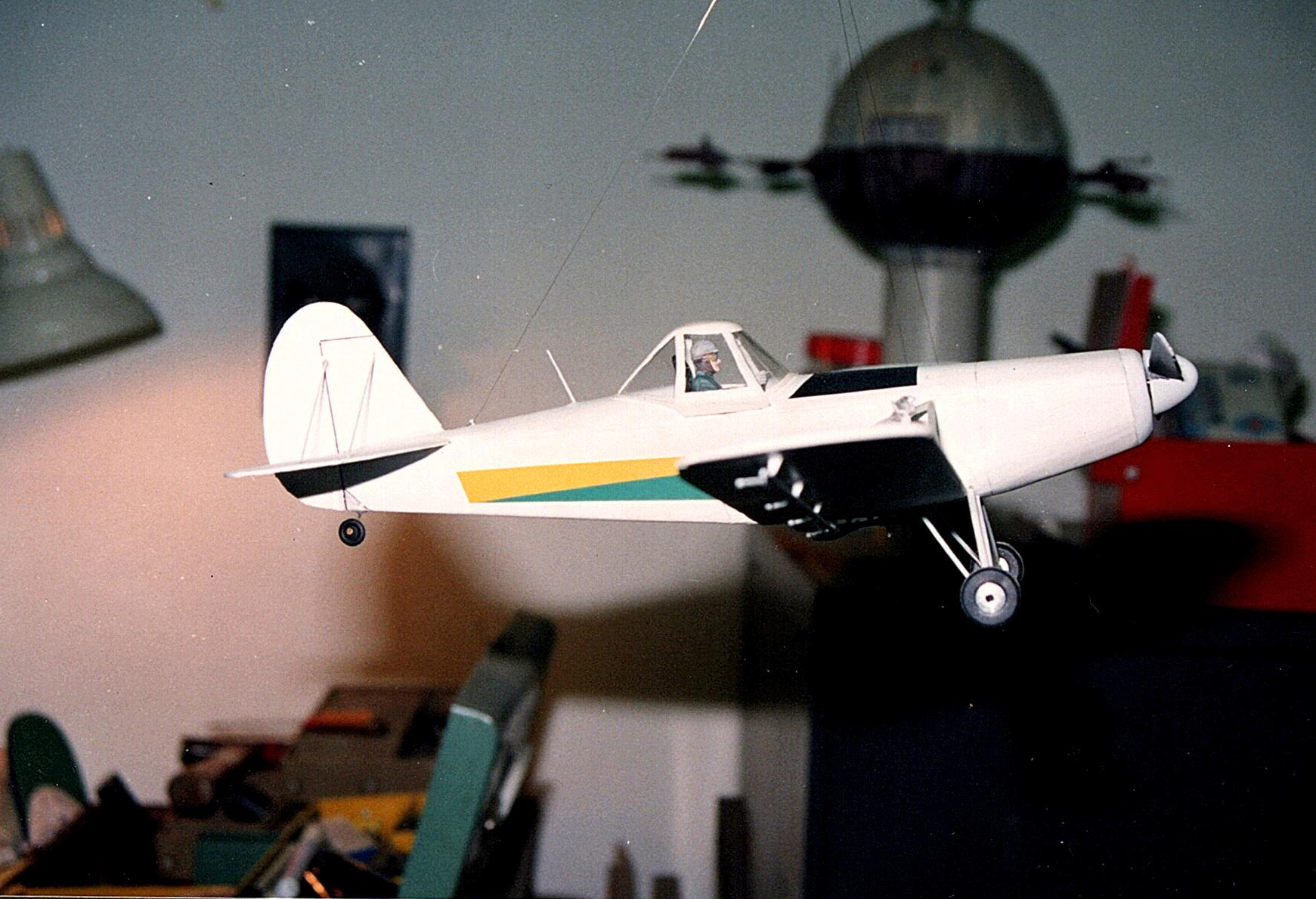
In one episode a full size crop duster aircraft is featured. I made up a small balsa kit of the aircraft to match the full size.

It had a small electric motor and a battery inside to spin the prop.It was only ever seen at a distance so was fairly simply detailed with some crop spraying pipes and nozzles under the wing as well as a matching livery to the full size aircraft.


In the photo above I am switching on the electric motor prior to the shot with Jaime Crooks the First AD (left).


For another episode a military General arrives at UMA base to chew everybody out in an eye bulging display of over the top acting and we needed a quick shot set up of his aircraft arriving. We used a few bits of the UMA base set and one of my own personal kit bashed aircraft projects for the scene. The only thing done to the aircraft model was to add some RAAF markings with an UMA triangle decal. As I remember the kit bash used two Airfix Vulcan kits joined to a B1 bomber nose and fuselage. The outer wing tips were from a Skyray. In the shot the aircraft is slowly rotating on the turntable as if it just landed. You can also see one of the 12 volt Phillips halogen miniature bayonet lamps mounted on the ground under the rear of the aircraft. This provided a bright flaring backlight, I think to represent landing lights, but mostly to add a bit of interest to a quickly cobbled together shot.
 
I never got that model back and have no idea what happened to it. I fact I never got any of my donated models back.


Saturday, 21 November 2020

Ultraman Towards the Future AKA Ultraman Great part 5

The Ultraman production purchased a collection of miniature buildings that were originally made for an unfinished version of Total Recall being made in Australia in 1987. The original miniatures supervisor for the 1987 Total Recall was Gene Rizzardi.

The miniatures had been stored in a shipping container outside in a paddock in Western Sydney for about two years. When we opened the shipping container we were hit with a wall of toxic fumes. We decided to wait with the doors fully open for about half an hour to get some fresh air to circulate before venturing inside to inspect the contents. The summer heat and winter cold had resulted in a expansion and contraction of all the glued joints of the model buildings and almost all of them were literally coming apart at the seams. They were chiefly made of acrylic (perspex) sheet that was just cemented together with very little structural reinforcement.

I gather when they were originally built they were made to be placed in a specific position in a miniature street set and not be moved again until they were finished shooting. The requirements for the Ultraman production would be that they were constantly shuffled around for different shots and stacked on top of each other to make different configurations. This meant that some sturdy timber reinforcement was required.

One of my tasks on Ultraman was to reassemble, repair and re-inforce all the buildings which occupied me for a some weeks.


The original miniatures were all made to depict a specific street in New York, namely Park Avenue. Here I am working on what used to be known as the Pan Am building  which was to be positioned right at the far end of the street.


You can see the side of this building had started to come off and I am attempting to re-glue it. The rest of the model considering all the small details survived surprisingly intact.


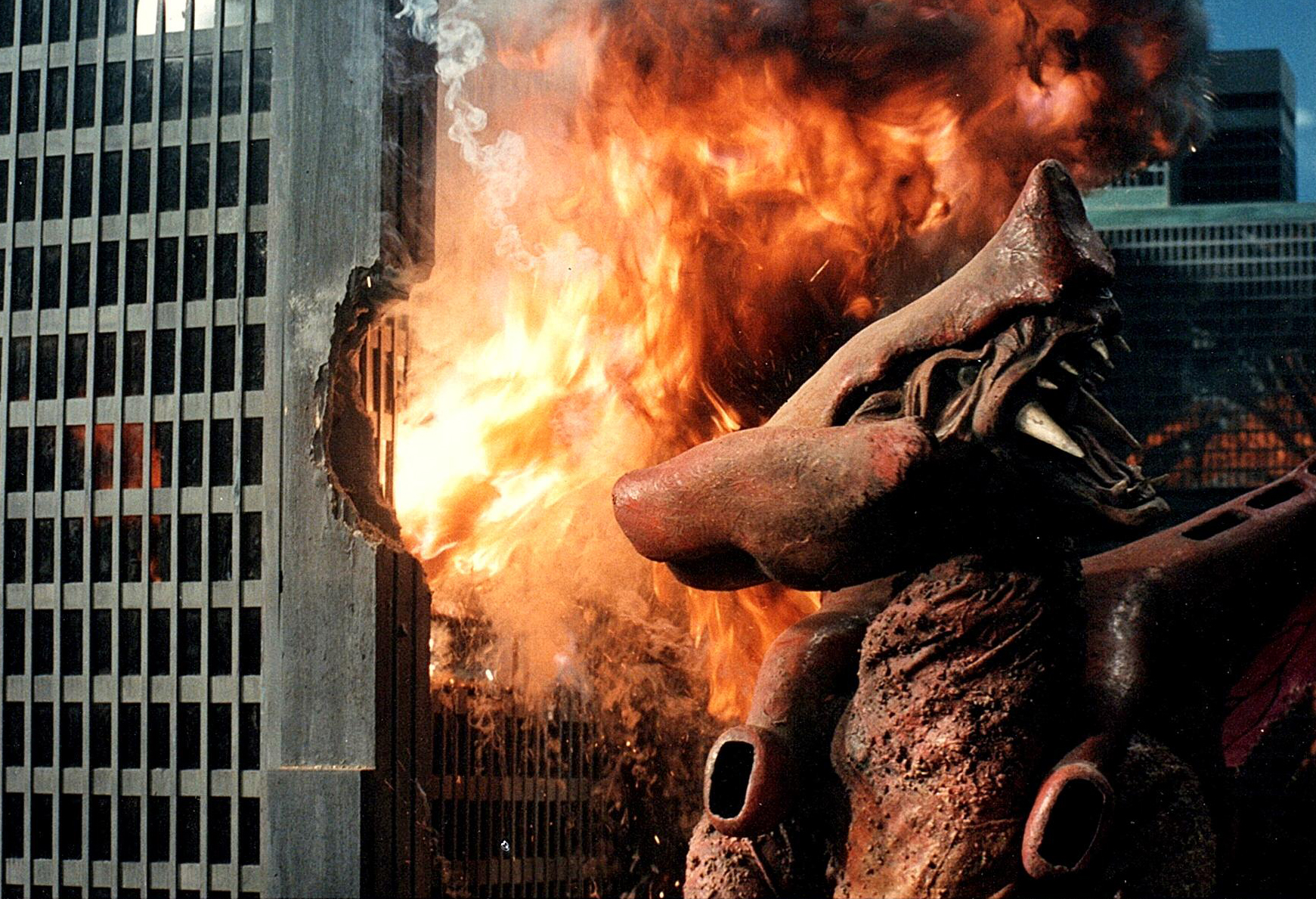
The picture below shows one of the buildings being used for a shattering window effect. Assistant director Jamie Crooks (left), Adam Grace (rear), Camera assistant Joanne Parker and D.O.P. Steve Newman setting up the shot.
The camera on the left of frame was an Arri SR a 16mm camera capable of 250 frames per second, a real workhorse and totally reliable. Jo the Camera assistant is hunched over the other 16mm camera we used, a Photosonics actionmaster capable of 500 frames per second. Unfortunately not so reliable and prone to jamming, but miniature explosions at 500 fps are gorgeous.


 A tiny air cannon was placed behind the window which blew out a thin piece of breakaway glass with extra debris piled up inside.


Here I am modifying one of the buildings for the first test of the breakaway glass and pyro explosion effect. Pre-damaged floors were added in and the facade was cut away to be replaced with breakaway glass and pre-painted strips to match the existing window frames.


The test was a deemed a success and the resulting footage was used in an episode.
 
The buildings were endlessly moved about and re-configured for different shots needing a city environment. The foreground cars were 1/24 scale plastic model kits.


The creature has a 1/24 scale car kit in its mouth which gets tossed aside and in a separate close up a 1/16 scale car hits the ground and explodes.


David Tremont is prepping another building for a pyro effect. We would have to chip off the existing detailing and cut away the perspex "glass" where we wanted the damage to appear. Sections of breakaway glass were carefully reinserted  and glued into the hole then strips of pre painted styrene to match the rest of the window mullions were lightly superglued back into position.


Judy Dabbs the Special Effects assistant towering over the architecture with two of the small Hummers on wires hung from a boom arm.


This a shot of the buildings as they were originally intended. This is the Park Avenue miniature set as it was built in 1987 for the aborted Total Recall movie that was going to star Patrick Swayze. The photos are courtesy of Adam Grace who although didn't contribute to this street set, worked on other miniatures for the unfinished production.
It was all built to be used with the Introvision system which was a front projection, in camera, compositing system that could place live action into a miniature scene using hold out mattes.
 

They had also built vehicles that used Tamiya Tamtech 1/24 scale radio controlled chassis that could drive down the street. I purchased one of them when the production had a big firesale upon winding up. I also got some other RC vehicles which were based on a modified Thunder Tiger Silver Fox chassis with Marui Big Bear Tyres on custom CNC aluminium wheels. I also picked up a Tamiya 1/16 scale RC Leopard tank chassis.
Unfortunately I dont have any of this haul any more except for a NorthWest Short Line Chopper, a tool I still use for cutting up Evergreen styrene strips.

 
The buildings were 1/24 scale at the front and tapered back to 1/100 scale in the very back to make the street look longer than it actually was.
The painters on the original miniatures crew did a pretty incredible job on these buildings.


I did not work on this show myself although I did have an interview with John Stears who was the visual Effects supervisor at the beginning of the production. John Stears was replaced quite early in the production and for whatever reason the three of us who went for an interview on the same day never got a call back.
 
Its a shame this version of the movie never got completed as there was even going to be a radio controlled vehicle car chase on the surface of mars all done with miniatures. That's something I would like to have seen.
 
Thanks for looking.


Sunday, 1 November 2020

Ultraman Towards the Future AKA Ultraman Great part 3

 Gigasaurus and the grassy plain environment.


Adam Grace and myself also built this grassy plain environment for the Gigasaurus episode.
We didn't have much time to build these sets so we needed solutions that were expedient. To get an instant grassy landscape we came up with the idea of using coconut matting used in the garden industry to make hanging basket liners. We managed to obtain a full roll of the stuff and just rolled it out over an array of raised rostra (wooden platforms) we constantly used throughout the show. Because our monsters were puppets we needed space underneath the sets to operate the feet of the creatures.


Shredded foam lumps were painted green and scattered with model railroad ground foam across the landscape for random plants and texture variation.

The coconut matting was brown in colour so it was painted in various shades of green using simple pump action garden sprayers and thinned water based paint. The distant hills were just scrunched up newspaper arranged in a pleasing formation under the matting and sprayed with bluer shades of green to make them appear further away on what was really quite a small set.  The picture below shows me wielding one of these sprayers. 


The road was just a simple piece of painted plywood screwed down over the matting into the baseboards of the platforms. The other notable aspect to this set is the sky backing, it's a really exemplary piece of work. We had two scenic artists on the show, the first was very junior and not quite up to the mark, the second was a more senior artist and was extremely talented. Good scenic art can make all the difference to a miniature.

The puppets were generally cable controlled using levers. The feet were operated with rods up through slots cut into the sets. As the puppet action was shot high speed all the puppeteers had to move pretty fast and be highly co-ordinated. It was sometimes quite comical to watch.

Two of the puppeteers Ross Browning and Ravi Prasad at the control levers with Steve Roswell one of the puppet makers.

The slots in the set had to be invisible to the camera for down shots. In the picture below Adam Grace is  hiding the edges of the slots cut in the matting.

The Gigasaurus puppet was also outfitted with a freezing breath gag which used liquid CO2 vented from its mouth.


Gigasaurus destroying an electrical sub-station with its freezing breath.

The puppet was supported by a steel pole which was mostly hidden by its tail. All the control cabling and the hose for the liquid CO2 freezing breath effect came down this pole.

The picture below shows Adam Grace (right) and myself attending to the rigging of the power lines. These were made from stainless steel fishing trace and had a nice weight to them so that they hung down realistically. they were also very strong and could withstand the inevitable entanglements with both puppet and the crew.


Gigasauraus supervising Adam Grace's work.

Two scales of transmission towers were scratch built by David Tremont plus a third smallest scale from plastic model railway kits.

Paul Nichola the visual effects supervisor shooting a POV shot from one of the Hummer flying vehicles with the puppet blasting its freezing breath at the camera.  

The same set was also used for a night scene. We used a string of the 24 volt figure eight lighting on sticks for a perimeter effect with small Phillips 12 volt halogen spotlights mounted on the set pointing at the critter. A dry ice mist added to the cold effect.


The Gigasaurus puppet along with all the others on the show was fabricated by a team consisting of Steve Roswell, Vicki Kite, Graham Binding, Norman Yeend and Warren Beaton.
 
Thanks for looking.


Most Popular Posts in the Last 7 Days